Disclaimer: The content on this website is for informational and educational purposes only and is not created to meet your personal financial situation. Nothing should be considered as investment advice or as a guarantee of profit. You are advised to consult with your financial advisors to discuss your investment options and whether it would be a suitable investment for your personal needs. The information used in this publication is from sources that are believed to be reliable but the accuracy cannot be guaranteed. It may include some errors, please make sure to do your due diligence. The opinions expressed are those of the author and the author only. These opinions are subject to change without prior notice. Scroll to the bottom for Bonus content! Made in Japan turned 2, today. I’m really blessed to see my readership and following growing more than I could possibly imagine. A benefit of this has been that I’ve been in a fortunate position to meet many, many great investors in Japan who are more successful than I am. The kind that has built life-changing wealth through the Japanese stock market. Over time, we’ve had some great conversations on investing and I’ve had the opportunity to pick their brains. Much of which has also helped me refine how I think about investing in Japan. What’s interesting is that many of these investors are not ‘classically trained’ investors, with no prior-financial career whatsoever. The takes were fresh and eye-opening. Coming from a classically trained institutional background, I learnt alot and at the same time it’s been a process of unlearning some old habits. Quite frankly none of these investors remind me of the ‘current’ Warren Buffett, and reminds me more of a Peter Lynch, or even Druckenmiller in some cases. Although I think it’s fair to argue to include Buffett in the early days in this. From a place of deep gratitude for my paid supporters, I wanted to share some of the mental notes that I took, through my own perspective and some of which I adapted for my own process. I’ve also been fortunate enough to meet alot of great investors abroad - and through those exchanges I’ve also learnt alot about the ‘other side’. It was also great to learn about the ‘contrast’ in thinking versus Japanese investors. In no way is this complete or the ‘right way’ to invest; everyone has their own game to play but I hope this can add an additional perspective on investing in this culturally unique market called Japan. It’s also helpful to me because I’ve never crystallised any of these thoughts in text before. lol. I warn you some of this is probably going to be quite controversial to the traditional fundamental investor, who may not like some of the things I say but that’s the point with this - Instead of regurgitating the gospel of value investing, I thought I’d share some hot takes which were shocking to me at first, some of them downright sinful, but ultimately stimulates thought. I’ll be talking about things like:
You may also even notice some contradictions in the things I say, which is fair reminder that alot of these are also very context dependent! Mind you, the market is a complex system that’s constantly evolving, and investor sophistication in Japan is evolving remarkably quickly - so some of this may become irrelevant in the future, in fact some might be already. Mainly because of the huge governance reforms we’ve seen over the past few years and we’re getting more international interest.Finally, please understand that this is my own interpretation, which is a subjective bias in itself. Once again, thank you for your support. It’s been so much fun to be able to write about things I’m passionate about; it’s thanks to you that I can. To start, since there are quite a few new readers of late (welcome!), I think it’s important to understand how I think about investing: 90% of the time, what I’m looking for are stocks that can double over a 2-3 year time frame. Doubling of stocks can happen more often than multibaggers which are inherently rare, so it fees like a much more repeatable process. 2-3 years feels right to be a short enough feedback loop that can be iterated and again more repeatable. Don’t get me wrong, I’d love a multi-bagger, my idea of a multibagger idea’s are ‘accidental’ ones. So, deciding whether a business is interesting after 2-3 years (or whenever it doubles) for the next 2-3 years. I guess I’m neither a short term investor or a long-term investor, maybe call it being a mid-term investor that sometime does long-term investing. Ideally, these would be in under-followed businesses with strong leadership in it’s niche if you’re willing to look under the hood. I like to think of Japanese companies as Dennis Rodman, seemingly doing crazy Sh*t, but often just very misunderstood and INSANELY good at what they do. There are many Dennis Rodmans. Typically, I’m looking for decent growth with a catalyst. My general belief is that investing is about investing in change and getting that right. This change is important here because it invites a new class of incremental investors. Which I’ve learnt to appreciate it to be crucial to the discovery process of undervalued (and underfollowed) businesses. More on this later. I like companies where there is no ‘consensus’ to begin with, and my favourite opportunity is when a company with no consensus ends up having some kind of consensus - which implies increased following on the company. I also count companies that have consensus numbers based on 1 or 2 analyst often from a small broker. That’s not consensus, that’s literally just 2 peoples opinion. If you must, the best reference point to look at might just be the 2-year forecast the Shikiho (Japan company handbook) provides not that it’s accurate (an editor has to cover hundreds of stocks at a time) but many Japanese investors refer to these numbers as a ‘baseline’ expectation. If you think in probabilities, I think there are really 2 ways to bet. Getting right on an certain event (i.e. a catalyst) and also betting on the change in probability of a future event. I much prefer the former as it’s more tangible, but am open to the latter. In terms of fundamentals, what I’m trying to do here is that I want to find something that can grow EPS and Re-rate to get to that 100% upside. I’ve had a long think about this, and if I had to summarise the way I invest into a single sentence, it’s “operating leverage”. Why? Because sustainable operating leverage i.e. margins expanding, usually implies improving business quality with both strong earnings growth and a re-rating, serving both things I’m looking for. The operating leverage also implies that there is revenue growth in there as well. So counterintuitively, I much prefer businesses that still have ‘low’ margins that can have high margins in the future. I also like it because it forces simplicity in the thesis, which the market can recognise, only that I want to be there before them. Conversely, I used to drool over high margin businesses but now I’ve become less excited about them due to the fact that I think 1) it implies potential maturity of the business (i.e. at mature margins) and 2) even if it’s not, the risk of where future margins could go are skewed to the downside. You can easily imagine a business trying to ‘invest more’ in an attempt to backstop decelerating growth, or just a competitor coming after your margin. These investments can be beneficial for sure, but might not fit my 2-3 year horizon.
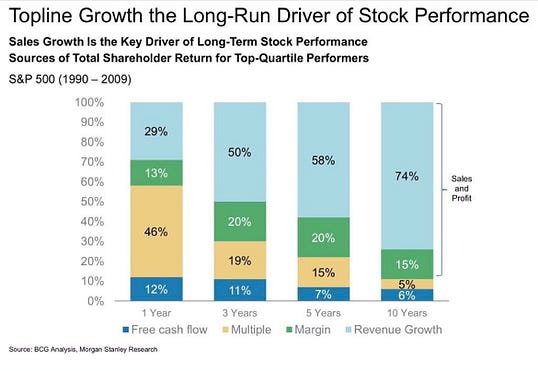
This is a classic chart; I think many fundamental investors have seen it once. An evolution I’ve gone through over these years is that I feel like I’ve looked at this chart wrong. My focus has shifted from the right two bars to the second and even the first bar. In the sense that the right ones de-emphasise multiple-expansion, and makes it sounds it’s not important but it’s what I want! The multiple expansion is my “margin of safety” because if starting multiples are reasonably low, it implies some kind of discount, and my bet is on that alleviating on some future event - and forces me to think of a catalyst that unlocks it. I try to be strict on the time horizon. In the sense that if something I anticipate doesn’t happen in my defined period, and instead happens in year 4 or 5 then I consider that getting it wrong. Too often, it’s easy to say oh XYZ didn’t happen, but thinking long-term, I think this can be recovered in Year N+3. Which is fine, but it’s just important to acknowledge that the initial thesis was wrong and you now have a new thesis. My ideal investment opportunity will look something like this:
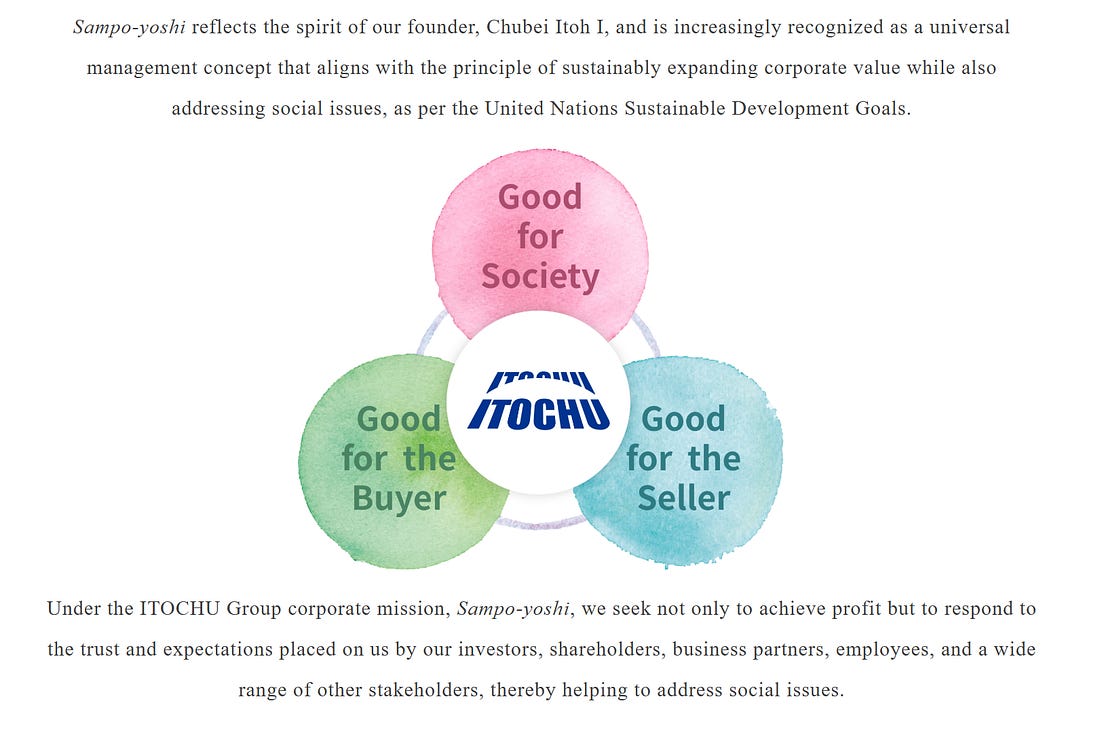
Though it’s unlikely to be able to find businesses that can tick all of the boxes, that’s what I strive to find. (… if you know of any let me know!!!) My non-Japanese friends and local friends invest quite differently. I’ve noticed a few differences; neither are wrong. I like to think my still-evolving philosophy as a synthesis of the two. Alright, enough about me. Here’s a thought experiment: Think of one of your dream watches, something expensive and shiny. A Rolex 6062 maybe, or a Patek Nautilus 5811 (no Richard Mille’s please). Now imagine you need to get this beautiful piece appraised and there are 3 rooms. One room has experts in precious metals, they actually don’t care whether it’s a watch, they just want to know the value of the metals used in the watch. Room 2 has experts who simply care about how much the price of that class of watch has changed since yesterday and how much it should change tomorrow. It’s not about the watch, or the precious metals in it, they just care how the price moves. In Room 3 you’ll find the watch connoisseurs, these people will appreciate the watches for what they are. They’ll place the value on, which vintage the watch is, or if this was part of a unique ‘batch’ that was even more special. They’ll look for the unique story for that particular time piece. None of them are ‘wrong’, just different. You can’t take your watch into the first room and try to forcefully convince them that the watch is worth more than the value of the gold used in that watch. This is what it feels like when you invest across the market cap spectrum from micro caps to large caps in Japan represented by these different rooms. This exists anywhere in the world, but perhaps more pronounced than any other country is that the ‘dominant’ investor types can behave so differently across the different market cap segments. Simply saying “these guys don’t get it” may put you in deep disappointment. More than you’d expect! Trust me, I know from all my painful experiences. This to me is also about having respect for the market. Simply enforcing your beliefs may not work. This I think, is the crux of why some investors in years past have said, “I don’t understand the Japanese Stock markets” Firstly, we are a coherent culture, meaning group-oriented. So this likely leads to more ‘groupthink’. Secondly, I generally think that the average Japanese investor is more short term oriented. Another dominant premise is that the nature of Japanese capitalism is different to that of the west, in my humble opinion. To be clear, capitalism works in Japan, and in some ways, I prefer our version more. It’s just that it’s not as efficient as the US, and it’s all the more important to understand how the market participants think which for cultural reasons and otherwise, can be different. That also doesn’t make it wrong, just different - and I will also try to share “how Japanese investors think” in an attempt to help you understand who’s on the other side of your trade. Also I wouldn’t dare say that I completely understand how many of these Japanese greats think, many of them have very different processes too. However, there were some common components that are the subject of this write-up. Here I’m focusing more on those fundamentally focused investors, although there are some very successful traders as well. Please see these notes as my own interpretation of some of the things they do, which has my own bias in itself. This is going to be a very long text (42 mins..) so I do apologise in advance… 1. Insider ownership is overratedWhat you often hear from many foreign investors is the instant excitement of “Oh high insider ownership!” of which there are many such companies in Japan. Come to think of it, I don’t think I’ve really ever had a discussion on insider ownership with my local peers. Now I said earlier that capitalism works in Japan, just not quite as well as it does in the US. Absolutely, you’d still like to see alignment of economic interest with those running it with the shareholders. The nuance here is that the ‘bond’ that aligns the shareholders to management i.e. equity may not be as strong as what you would see in the US - and you need to be careful with it. The reality is that Japanese management like money, but doesn’t like it as much as the typical American CEO. Some of that capitalist mindset if there was any got lost in the post 80s bubble. For many Japanese CEOs, money isn’t the driving force that motivates them, that there is more to life than wealth. They have alot more of a stakeholder mindset which for better or for worse have come at the expense of the shareholder. You can see this in private equity too. In Japan, you can’t buy a company off an owner if you pile up enough money. No, they want to know how you’re going to help prolong the legacy of the business, and how you’re going to treat the employees once it changes hands. Many would rather close down than put it in the wrong hands. In Japan we have a philosophy called Sampo-Yoshi (三方良し)Which means good in three ways: for the seller, the customer and society. This old concept has been ingrained in the minds of many Japanese businesses that stand today. Itochu, one of Buffet’s investments in Japan, has this as one of their core philosophies even now.
Given Japan has been so disinterested in the equity markets for the last 30 years, I suspect many Japanese execs also still don’t quite understand the power of equity! You will be amazed at how many employees still prefer to be compensated in cash over company shares. There are other traps unique in Japan to consider too: ... Subscribe to Made In Japan to unlock the rest.Become a paying subscriber of Made In Japan to get access to this post and other subscriber-only content. A subscription gets you:
|
Sunday, February 22, 2026
How the best Japanese Investors Think






Subscribe to:
Post Comments (Atom)
No comments:
Post a Comment